
CARD FILE / 00-77
Two of Swords Tarot Card Meaning
Two of Swords centers on a relationship between two forces within thought, language, conflict, truth, and decision. In a reading, it asks the reader to connect the traditional image with the actual question, current facts, and position in the spread. Its message changes when it describes a cause, a present pattern, an obstacle, advice, or a likely direction.
The short key is exchange and polarity through thought, language, conflict, and decision. The longer interpretation below keeps the card specific while leaving room for context, agency, and more than one plausible reading.
Upright keywords
- Exchange and polarity through thought, language, conflict, and decision
- a relationship between two forces within thought, language, conflict, truth, and decision
- discernment and the ability to name what is happening
- Two of Swords
Reversed keywords
- choice can become delay when both options remain abstract; in Swords, this can appear as rumination, defensiveness, or using analysis to avoid contact
- blocked or internalized expression
- a need to review pace and context
01
Two of Swords overview
Two of Swords belongs to the Swords suit and carries the Two stage of that suit's story. Swords is associated with Air and with thought, language, conflict, truth, and decision. The Two brings a relationship between two forces, so this card is less a fixed verdict than a description of how that stage is behaving in the current question.
At its clearest, this card describes a relationship between two forces within thought, language, conflict, truth, and decision. That may be an outer event, an inner posture, a relationship dynamic, or a decision that has reached a recognizable stage. A responsible reading does not force every symbol into one prediction. It asks what part of the image resembles the lived situation and what new question becomes possible because the pattern has been named.
02
Upright meaning
Upright, Two of Swords usually brings the card's central movement into direct view: a relationship between two forces within thought, language, conflict, truth, and decision. It can indicate that the relevant energy is available, visible, or ready to be used consciously. “Upright” does not automatically mean easy or positive. It means the card's main lesson is expressed more openly, including the responsibility that comes with it.
With Two of Swords, look for the choice hidden inside the image and test it against a relationship between two forces within thought, language, conflict, truth, and decision. Ask what this particular card encourages you to begin, protect, release, communicate, or examine. Then translate that answer into something observable. A useful Two of Swords interpretation should help a person see the situation more accurately and choose a proportionate response, not merely feel impressed by symbolic language.
03
Reversed meaning
Reversed, Two of Swords can show choice can become delay when both options remain abstract; in Swords, this can appear as rumination, defensiveness, or using analysis to avoid contact. Reversal may describe delay, excess, internalization, avoidance, or a private version of the upright theme. It does not automatically turn the card into its opposite, and it should not be used to create fear.
For a reversed Two of Swords, begin by asking whether a relationship between two forces within thought, language, conflict, truth, and decision is missing, overused, or operating out of sight. The distinction matters because the likely correction changes with the cause: absence needs support, excess needs proportion, delay needs timing, and resistance needs an honest reason. The surrounding cards and the user's question help determine which version of choice can become delay when both options remain abstract; in Swords, this can appear as rumination, defensiveness, or using analysis to avoid contact is most credible.
04
Love and relationships
In love readings, Two of Swords brings the Two stage into communication, assumptions, boundaries, and the stories shaping the bond. It can describe what is being offered, defended, desired, or avoided. The card is most useful when it directs attention toward mutual behavior rather than claiming access to another person's private thoughts.
If Two of Swords appears for a developing connection, ask what pace and level of clarity its theme of a relationship between two forces within thought, language, conflict, truth, and decision can actually support. In a long-term bond, ask where that pattern is maintained by habit and whether both people experience it the same way. Use this card's symbolism to open a conversation, not to replace one.
05
Career and money
Career
For career, Two of Swords focuses on strategy, critique, negotiation, workload pressure, and difficult decisions. The Two stage suggests a relationship between two forces, which can help distinguish a beginning from a plateau, conflict, completion, or leadership question.
Check Two of Swords against material facts: responsibilities, deadlines, compensation, support, and the decision actually available. Its emphasis on a relationship between two forces within thought, language, conflict, truth, and decision becomes more useful when it changes a practical plan rather than remaining an attractive abstraction.
Money
In money readings, Two of Swords highlights planning, contracts, financial anxiety, and the facts that need to be separated from fear. It asks whether the current response fits the evidence and whether the pattern is sustainable beyond the immediate emotion.
Tarot should not replace financial advice. Use Two of Swords to identify assumptions connected to a relationship between two forces within thought, language, conflict, truth, and decision, then verify numbers, terms, risks, and obligations through appropriate sources before acting.
06
Feelings and advice
As feelings
As a feelings card, Two of Swords can describe a person experiencing a relationship between two forces within thought, language, conflict, truth, and decision. Feelings are not promises or verified intentions. The card may reflect the reader's perception, the atmosphere between people, or an emotional capacity that has not yet become action.
A grounded Two of Swords reading asks what behavior would confirm that a relationship between two forces within thought, language, conflict, truth, and decision is present and what other explanation remains possible. That comparison protects the reading from turning uncertainty into false certainty.
Advice
What becomes clearer when the alternatives are named honestly?. Let that sentence become a testable instruction rather than a slogan. Decide what you will observe, what boundary or action belongs to you, and when you will review the result.
If Two of Swords creates urgency around a relationship between two forces within thought, language, conflict, truth, and decision, slow down enough to check consequences. If it creates hesitation, reduce the next step until it can be done. Advice from this card is useful when it increases agency without pretending to control other people or future events.
07
Spiritual meaning and yes or no
Spiritual reflection
Spiritually, Two of Swords can be contemplated as a practice of a relationship between two forces within thought, language, conflict, truth, and decision. This does not require supernatural certainty. The card can function as an archetypal image that helps a person notice where values, fear, desire, and responsibility are meeting.
Yes or no
Two of Swords leans toward a conditional answer rather than a simple verdict. It supports “yes” when the situation can honor the card's central quality and the facts are consistent with it. It leans “not yet” or “no” when choice can become delay when both options remain abstract; in Swords, this can appear as rumination, defensiveness, or using analysis to avoid contact is controlling the decision.
For Two of Swords, write the condition beside the answer and connect it to a relationship between two forces within thought, language, conflict, truth, and decision: a yes requires evidence that the central quality can be expressed, while a not-yet names what must change first. That condition is more useful than a binary label because it identifies the information or action that could change the direction.
08
Imagery and symbolism
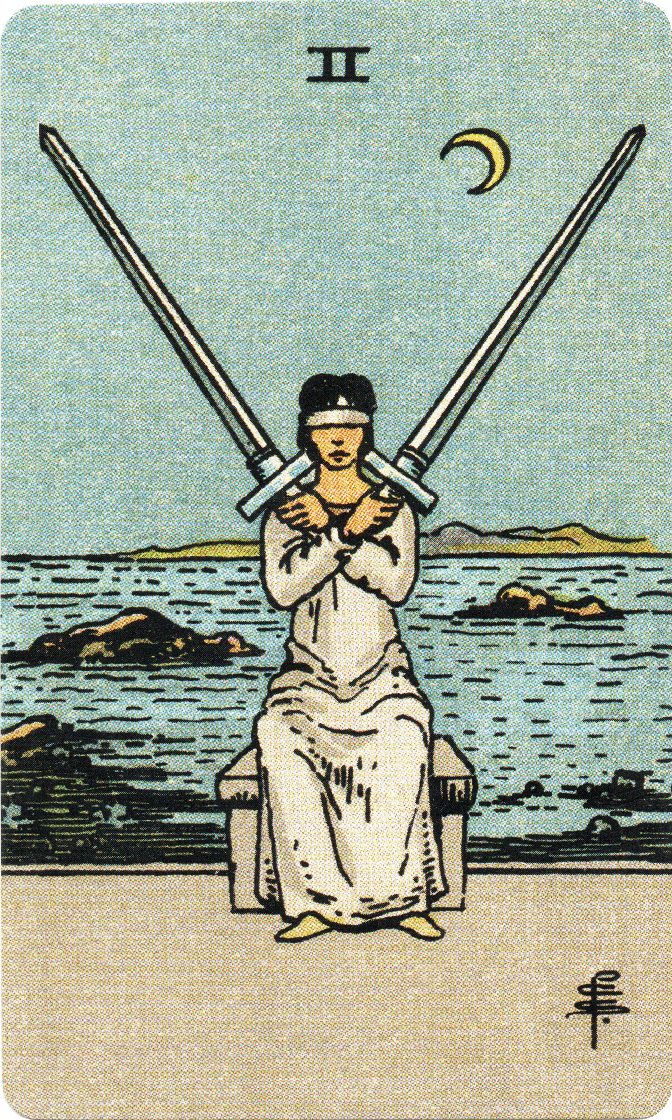
The traditional image emphasizes the blade divides and clarifies; its direction reveals whether thought protects, attacks, or liberates; the pair pattern gives the scene its developmental stage. Rather than memorizing a list, notice direction, posture, distance, weather, color, and what the figure is holding or looking toward. Visual details can reveal whether the card feels active, receptive, protected, exposed, expanding, or contracting in this particular spread.
This Two of Swords image comes from a classic public-domain tarot tradition. Other decks may alter the clothing, setting, and emphasis of the blade divides and clarifies; its direction reveals whether thought protects, attacks, or liberates; the pair pattern gives the scene its developmental stage, but the reading remains strongest when the actual artwork in front of the reader is examined instead of treated as decoration.
QUESTIONS
Questions about this subject
What does Two of Swords mean upright?
Upright, Two of Swords highlights a relationship between two forces within thought, language, conflict, truth, and decision. Read it through the question and spread position rather than treating the phrase as a fixed prediction.
What does Two of Swords mean reversed?
Reversed, it can point to choice can become delay when both options remain abstract; in Swords, this can appear as rumination, defensiveness, or using analysis to avoid contact. Check whether the theme is blocked, excessive, delayed, or operating privately.
Is Two of Swords a yes or no card?
It is best read conditionally. The answer depends on whether the situation can express the card's central quality without repeating its shadow.
What does Two of Swords mean in love?
It describes how a relationship between two forces within thought, language, conflict, truth, and decision may be influencing reciprocity, attraction, safety, or choice. Observable behavior remains more reliable than assumed private thoughts.
How should I use this card as advice?
What becomes clearer when the alternatives are named honestly?. Translate the message into one action or question that can be checked in ordinary life.